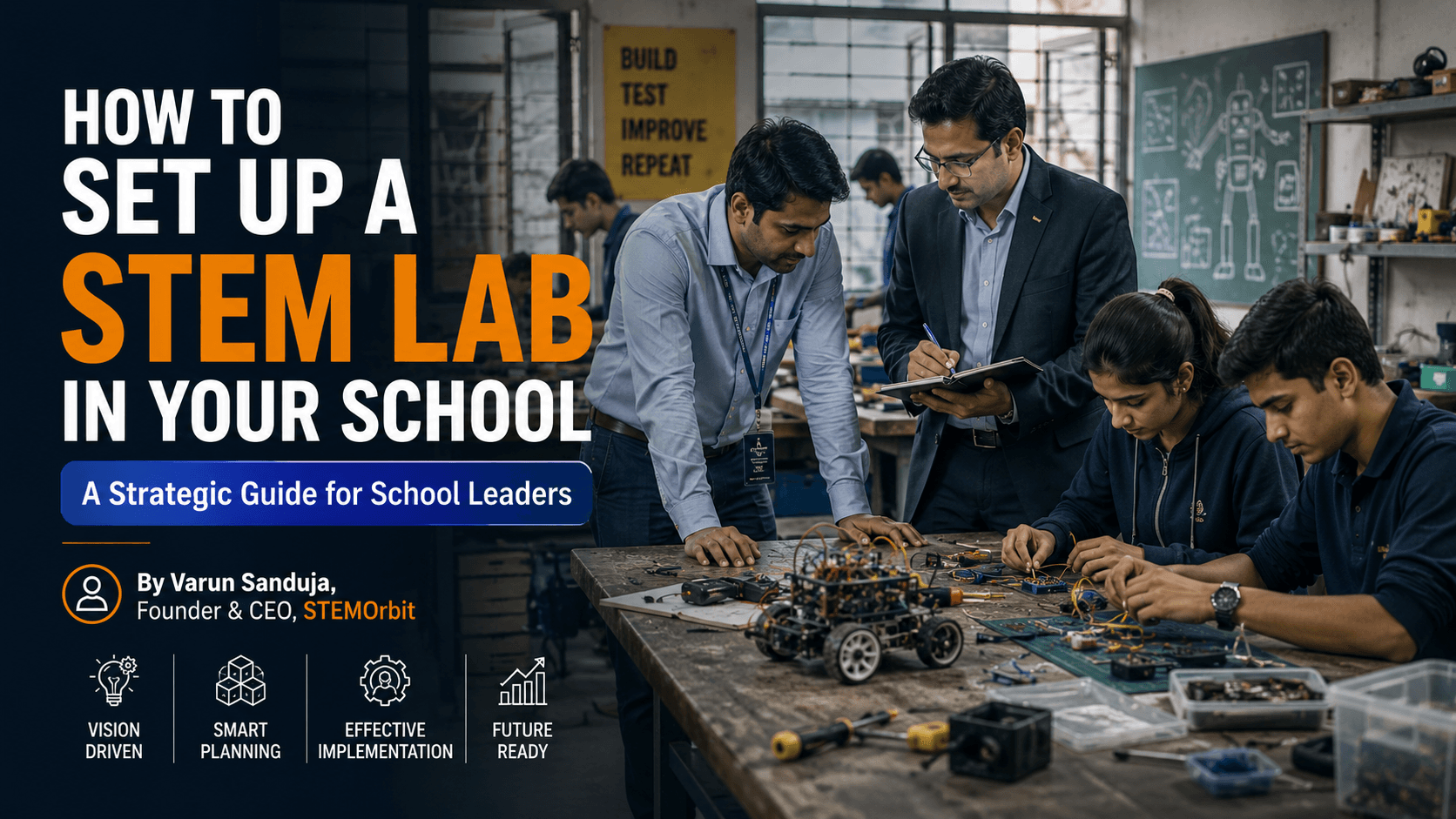
How to Set Up a STEM Lab in Your School: A Strategic Guide for School Leaders
A Strategic Guide for School Leaders
By Varun Sanduja, Founder & CEO, STEMOrbit
Across India, schools are increasingly investing in STEM and Robotics Labs to prepare students for a technology-driven future. However, one common mistake many institutions make is focusing on infrastructure before defining outcomes.
Having worked with more than 400 schools to establish STEM and Robotics Labs, I have observed that the most successful programs are not necessarily the most expensive ones. They are the ones that are strategically planned around the school's vision, student needs, and long-term educational goals.
Before purchasing equipment or allocating space, school leaders should carefully evaluate several key factors that will determine the success of their STEM initiative.
A STEM Lab Is Not a Room—It's a Learning Ecosystem
Many schools envision a STEM Lab as a dedicated room filled with robotics kits, computers, and advanced technology. While infrastructure is important, it is only one part of the equation.
A successful STEM Lab should:
- Foster creativity and innovation
- Develop critical thinking and problem-solving skills
- Encourage hands-on learning
- Promote collaboration and teamwork
- Prepare students for future careers and emerging technologies
The goal should not be to build a showcase facility. The goal should be to create meaningful learning experiences for students.
Step 1: Understand Your Student Population
The first step in planning a STEM Lab is understanding how many students will participate and how the program will be delivered.
Important considerations include:
- Total school strength
- Grade-wise student distribution
- Number of sections per grade
- Weekly STEM periods available
- Expected batch sizes
A school with 500 students will require a very different implementation model than a school with 3,000 students. Planning based on actual student numbers ensures optimal utilization of resources and avoids unnecessary expenditure.
Step 2: Define the Purpose of Your STEM Program
Before deciding on equipment or curriculum, schools must clearly define why they are establishing a STEM Lab.
Option 1: STEM for Every Student
The objective is to provide hands-on STEM education to all learners.
This model focuses on:
- Foundational STEM concepts
- Design thinking
- Creativity and innovation
- Problem-solving skills
- Technology awareness
The emphasis is on building future-ready skills across the entire student population.
Option 2: Competitive Excellence Program
Some schools wish to develop a specialized team that can participate in robotics, coding, AI, drone, and innovation competitions.
This model focuses on:
- Advanced robotics
- Coding and programming
- Artificial intelligence
- Engineering design
- Competition preparation
The infrastructure, curriculum, and budget requirements for this approach differ significantly from a school-wide STEM program.
Step 3: Evaluate the Available Space
One of the biggest misconceptions about STEM Labs is that they require a large dedicated facility.
In reality, the ideal setup depends on:
- Student capacity
- Activity types
- Storage requirements
- Future expansion plans
- Classroom utilization strategy
Many schools successfully operate STEM programs in spaces ranging from 400 to 800 square feet. What matters most is thoughtful design and efficient utilization of the available area.
A well-planned compact lab often delivers better outcomes than a large space that lacks structure and purpose.
Step 4: Establish a Realistic Budget
The question should not be:
"How much will a STEM Lab cost?"
The better question is:
"What outcomes do we want our students to achieve?"
Budget planning should include:
- STEM and robotics kits
- Learning resources
- Curriculum and content
- Teacher training
- Annual maintenance
- Competition participation
- Program management and support
Schools that adopt a phased implementation approach often achieve better results than those that invest heavily in infrastructure from the beginning.
Step 5: Focus on Teacher Training
Even the most advanced STEM Lab will fail to deliver results if teachers are not confident in using the resources effectively.
A successful implementation must include:
- Faculty orientation
- Hands-on teacher training
- Lesson planning support
- Continuous professional development
- Assessment and progress tracking
Teachers are the driving force behind any successful STEM program.
Step 6: Plan for Long-Term Sustainability
A STEM Lab should not become a room that students visit occasionally. It should become an integral part of the school's learning culture.
Schools should develop a long-term roadmap that includes:
- Grade-wise progression
- Project-based learning
- Innovation showcases
- STEM exhibitions
- Inter-school competitions
- Industry and community engagement
The most impactful STEM programs evolve continuously and grow alongside student aspirations.
The STEMOrbit Approach
At STEMOrbit, we believe schools should avoid investing in expensive infrastructure before understanding their actual requirements.
Our implementation process begins with a detailed consultation to understand:
- Student strength and demographics
- Educational objectives
- Infrastructure availability
- Budget constraints
- Faculty readiness
- Future growth plans
Based on these parameters, we design a customized STEM roadmap that aligns with the school's vision and ensures maximum return on investment.
This practical approach has enabled us to successfully establish more than 400 STEM and Robotics Labs across schools while ensuring high student engagement and measurable learning outcomes.
Final Thoughts
Setting up a STEM Lab is not about purchasing equipment. It is about creating opportunities for students to think, build, innovate, and solve real-world problems.
The most successful schools begin with a clear vision, make informed decisions, and focus on student outcomes rather than infrastructure alone.
Before investing in a STEM Lab, consult an experienced implementation partner who can help evaluate your needs, optimize your budget, and design a sustainable program that delivers long-term impact.
Because the future of STEM education is not built through technology alone—it is built through purposeful learning experiences.
About the Author
Varun Sanduja is the Founder & CEO of STEMOrbit and has successfully designed and implemented more than 400 STEM and Robotics Labs across schools. His mission is to help schools transform students from passive screen consumers into confident creators, innovators, and future-ready problem solvers.