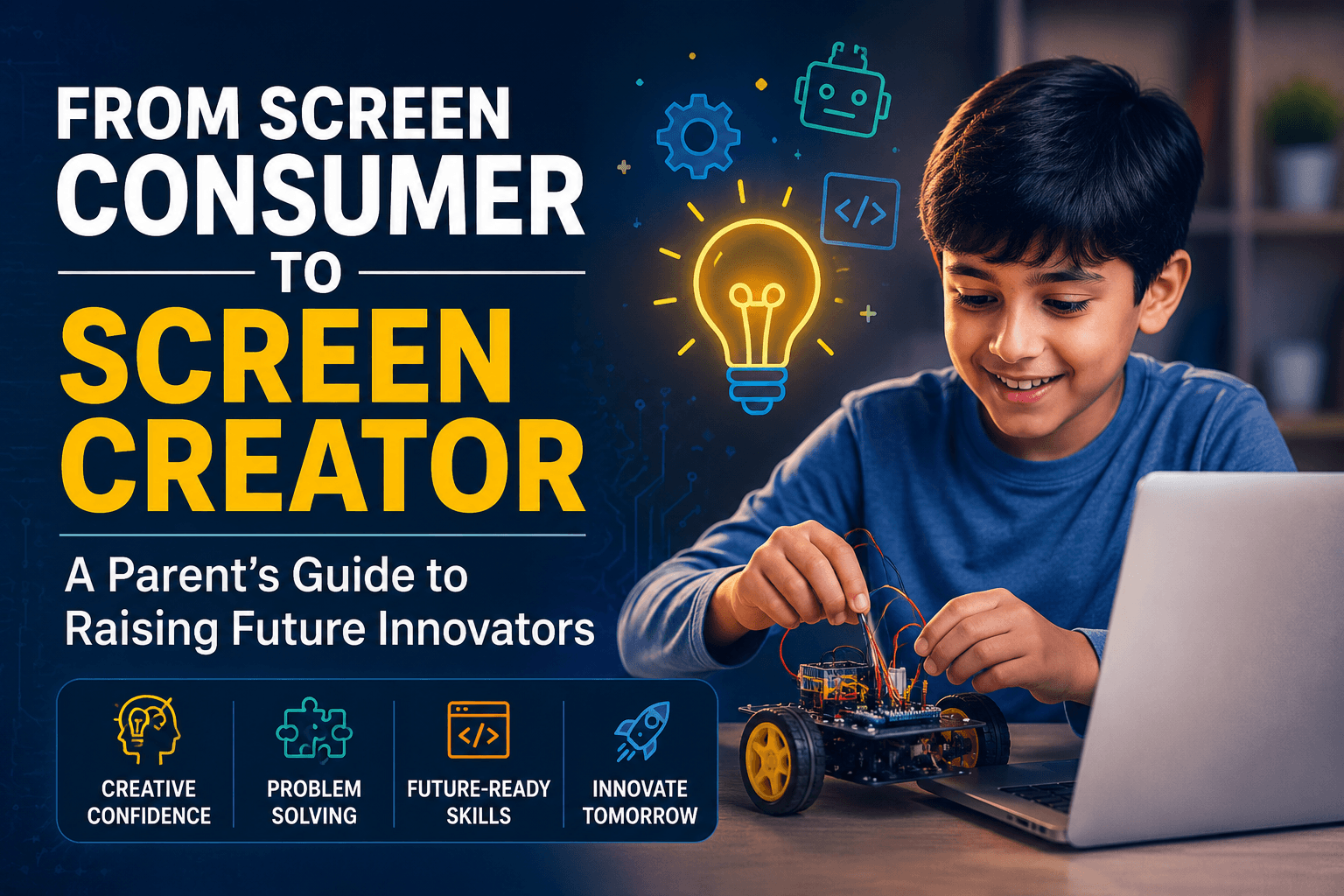
Screen to Creator: A Parent's Guide to Raising Future Innovators
From Screen Consumers to Future Creators: Reimagining Children's Relationship with Technology
In today's digital age, screens have become an inseparable part of childhood. Whether for learning, entertainment, communication, or recreation, children spend a significant portion of their day interacting with digital devices.
As parents and educators, the conversation often revolves around one question: "How can we reduce children's screen time?"
While this concern is valid, perhaps the more important question is:
How can we transform screen time into a meaningful opportunity for creation, innovation, and learning?
The Challenge of Passive Consumption
Most digital experiences available to children are designed for consumption. Endless scrolling, video streaming, casual gaming, and social media engagement encourage children to absorb content rather than actively contribute to it.
Passive consumption may provide temporary entertainment, but over time it can limit opportunities to develop essential skills such as critical thinking, creativity, problem-solving, and independent exploration.
The issue is not technology itself. The issue lies in how technology is being used.
A New Perspective: Technology as a Creation Tool
The same device that delivers entertainment can also become a powerful platform for innovation.
When children transition from consumers to creators, technology evolves from a source of distraction into a catalyst for learning and growth.
Instead of merely watching videos, children can create digital content. Instead of simply playing games, they can learn to design and develop them. Rather than interacting passively with technology, they can use it to build solutions, solve problems, and bring their ideas to life.
This shift in mindset is critical for preparing young learners for the future.
Why Creating Matters More Than Consuming
Creation demands active engagement. It encourages children to think, experiment, and persist through challenges.
When children build, design, code, invent, and explore, they naturally develop:
Creative Confidence
The belief that their ideas have value and can be transformed into real-world outcomes.
Problem-Solving Skills
The ability to identify challenges, analyze possibilities, and develop solutions.
Critical Thinking
The habit of questioning, evaluating, and improving ideas rather than accepting information passively.
Future-Ready Competencies
Skills such as computational thinking, design thinking, engineering fundamentals, and digital literacy are becoming increasingly important in a technology-driven world.
These capabilities extend far beyond academics and will remain valuable regardless of future career choices.
The Role of STEM Education
STEM education—Science, Technology, Engineering, and Mathematics—provides a practical pathway for transforming children into creators.
Unlike traditional learning models that emphasize memorization, STEM learning focuses on exploration, experimentation, and hands-on application.
Children engage with concepts by:
- Building electronic circuits
- Designing engineering solutions
- Programming robots
- Developing coding projects
- Creating prototypes
- Exploring emerging technologies
Through these experiences, learning becomes active, meaningful, and memorable.
Most importantly, children begin to see themselves not just as users of technology, but as innovators capable of shaping it.
What Parents Can Do
Parents play a crucial role in guiding this transformation.
Simple actions can make a significant difference:
- Encourage project-based learning activities.
- Introduce age-appropriate STEM experiences.
- Promote curiosity and experimentation.
- Celebrate effort, creativity, and persistence.
- Replace a portion of entertainment-focused screen time with creation-focused activities.
The objective is not to eliminate screens but to elevate how they are used.
Preparing Children for the Future
The future will belong to individuals who can think critically, adapt continuously, and create meaningful solutions to complex challenges.
Our children will inherit a world shaped by artificial intelligence, automation, robotics, and emerging technologies. To thrive in this environment, they must become more than consumers of technology—they must become creators, innovators, and problem-solvers.
Every child possesses the natural curiosity and creativity required to build, invent, and explore. With the right guidance, technology can become a powerful vehicle for unlocking that potential.
The goal is not simply to reduce screen time.
The goal is to transform screen time into creator time.
Because the leaders of tomorrow will not be those who consumed the most content—they will be those who learned to create it.
From Screen Consumer to Screen Creator: Building the Skills That Shape the Future.