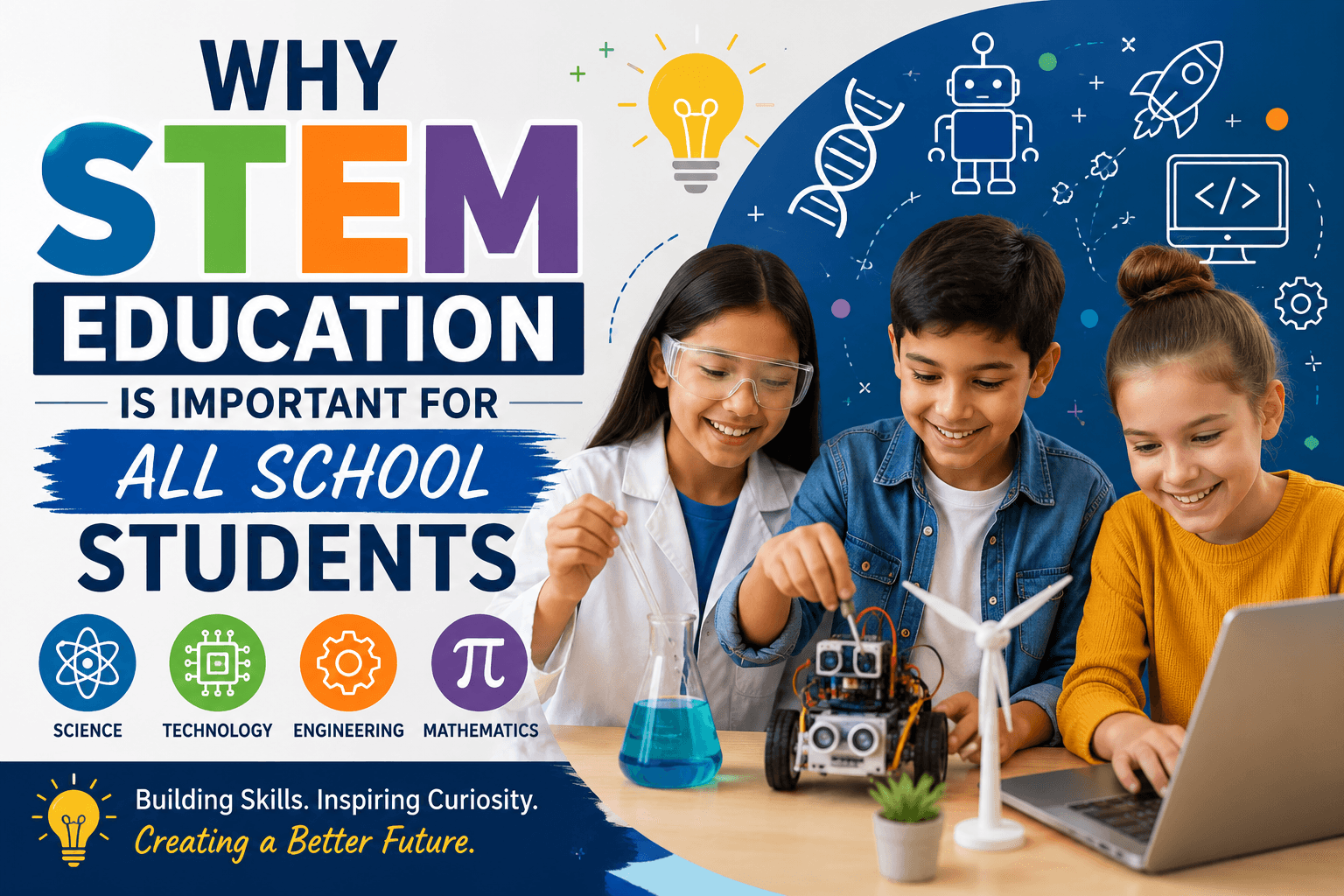
Why STEM Education is Important for All School Students
Why STEM Education is Important for All School Students
In today's rapidly changing world, education must prepare students not only for exams but also for real-life challenges and future careers. One of the most effective ways to achieve this is through STEM education. STEM stands for Science, Technology, Engineering, and Mathematics. These four disciplines work together to help students develop critical thinking, creativity, problem-solving abilities, and practical skills that are essential in the modern world.
Building Problem-Solving Skills
STEM education encourages students to analyze problems, think logically, and find innovative solutions. Rather than simply memorizing facts, students learn how to apply their knowledge to real-world situations. Whether it is designing a simple machine, conducting a science experiment, or writing a computer program, STEM activities help students become confident problem solvers.
Preparing Students for Future Careers
The demand for STEM-related jobs is growing across the globe. Careers in fields such as artificial intelligence, software development, robotics, healthcare, renewable energy, and data science are expanding rapidly. By introducing STEM concepts at an early age, schools can help students develop the skills needed to succeed in these high-demand professions.
Encouraging Innovation and Creativity
Many people believe that STEM is only about numbers and calculations. In reality, STEM education promotes creativity by encouraging students to design, build, experiment, and innovate. Students learn to think outside the box and develop unique solutions to challenges, fostering an entrepreneurial mindset that can benefit them throughout their lives.
Developing Technological Literacy
Technology has become an integral part of everyday life. From smartphones and computers to smart homes and online learning platforms, technology surrounds us. STEM education helps students understand how technology works and how they can use it effectively and responsibly. This technological literacy is essential for success in the digital age.
Promoting Teamwork and Communication
Many STEM projects require students to work together in groups. Through collaboration, students learn valuable communication, leadership, and teamwork skills. These soft skills are highly valued by employers and are important for success in both academic and professional environments.
Connecting Learning to Real Life
One of the greatest strengths of STEM education is its ability to connect classroom learning with real-world applications. Students can see how mathematical formulas, scientific principles, and technological concepts are used to solve everyday problems. This practical approach makes learning more engaging and meaningful.
Building Confidence and Curiosity
STEM activities encourage students to ask questions, explore new ideas, and learn from failure. When students successfully complete a project or solve a challenging problem, they gain confidence in their abilities. This confidence motivates them to continue learning and exploring new opportunities.
Conclusion
STEM education is no longer optional - it is a necessity for preparing students for the future. By developing critical thinking, creativity, technological literacy, and problem-solving skills, STEM education equips students with the tools they need to thrive in an increasingly complex and technology-driven world. Every school student, regardless of their future career path, can benefit from STEM learning. Investing in STEM education today means building a generation that is ready to innovate, lead, and shape a better tomorrow.